Retail Corporate Merchandise Revolution: How Brick-and-Mortar Brands Are Winning With Strategic Swag in 2026
In an era where e-commerce continues to capture headlines, the retail industry is experiencing a quiet renaissance in physical branding. Behind the scenes of flagship stores and outlet malls, retail executives are reimagining corporate merchandise as a strategic lever for brand differentiation, customer loyalty, and workforce engagement.
The shift represents more than aesthetic evolution. As retail brands compete for consumer attention and top talent, thoughtful swag programs have emerged as competitive moats—creating tangible brand experiences that digital channels simply cannot replicate.
The State of Retail Branding in 2026
Today’s retail environment demands more thanlogo-embroidered tote bags. With consumer expectations at an all-time high and employee retention becoming a critical challenge, retail organizations are treating merchandise programs as C-suite strategic initiatives rather than afterthought marketing expenses.
According to industry projections, retail brands increased their branded merchandise budgets by 23% in 2025, with particular investment in quality over quantity—a departure from the promotional product flooding of previous decades. The reasoning is straightforward: a premium item that customers actually use delivers far greater brand impressions than dozens of disposable giveaways.
Luxury retailers, department stores, specialty brands, and emerging retail concepts are converging on a common truth: the item someone carries or wears becomes a walking billboard, but only if it meets standards worthy of their personal brand.
Strategic Merchandise Categories Dominating Retail
Premium Apparel as Brand Ambassadorship
Retail brands have discovered that when employees and customers wear branded apparel, it transforms everyday individuals into brand ambassadors. The key shift in 2026 involves quality elevation—moving beyond basic cotton t-shirts to premium fabrics, sustainable materials, and thoughtful design that people actually want to wear beyond work hours.
Premium outerwear, particularly lightweight jackets and sustainable fleece, has become the flagship category for retail corporate merchandise programs. Brands like Patagonia and Everlane have long championed quality apparel, and now their corporate gifting programs reflect these values. A well-crafted branded jacket worn on a commute or weekend outing generates impressions that paid advertising cannot buy.
Retail organizations are particularly investing in apparel that serves dual purposes: professional enough for in-store roles, stylish enough for off-duty wear. This strategic overlap maximizes brand exposure while respecting employee individuality.
Eco-Conscious Drinkware and Lifestyle Products
Sustainable drinkware has become non-negotiable in retail merchandising strategies. Reusable water bottles, coffee tumblers, and insulated drinkware serve triple purposes: environmental responsibility, daily utility, and continuous brand visibility.
The reasoning is data-backed. Research indicates that a high-quality reusable bottle remains in active use for 3-4 years, generating thousands of brand impressions during its lifespan. Compare this to single-use promotional items that end up in landfills within weeks, and the ROI calculation becomes obvious.
Specialty retailers, particularly those in outdoor, lifestyle, and wellness categories, are leading this charge. Their merchandise programs align with brand values around sustainability while delivering practical items that customers genuinely appreciate.
Tech-Integrated Merchandise
Forward-thinking retail brands are incorporating technology into their merchandise programs in meaningful ways. Wireless charging pads branded with company logos, smart water bottles that track hydration, and Bluetooth-enabled accessories have moved from novelty to necessity in premium corporate gift sets.
For retail brands targeting tech-savvy consumers and employees, these items signal innovation and awareness. They also solve a practical problem: people genuinely need these products, ensuring the branded items aren’t discarded or regifted immediately.
Retail Events and Trade Show Strategies
From the National Retail Federation’s Big Show to regional buyer’s markets and industry summits, retail events represent prime opportunities for strategic merchandise deployment. However, the approach has matured significantly from the era of logo-stamped candy bowls and cheap pens.
Successful retail brands in 2026 are segmenting their trade show swag strategically:
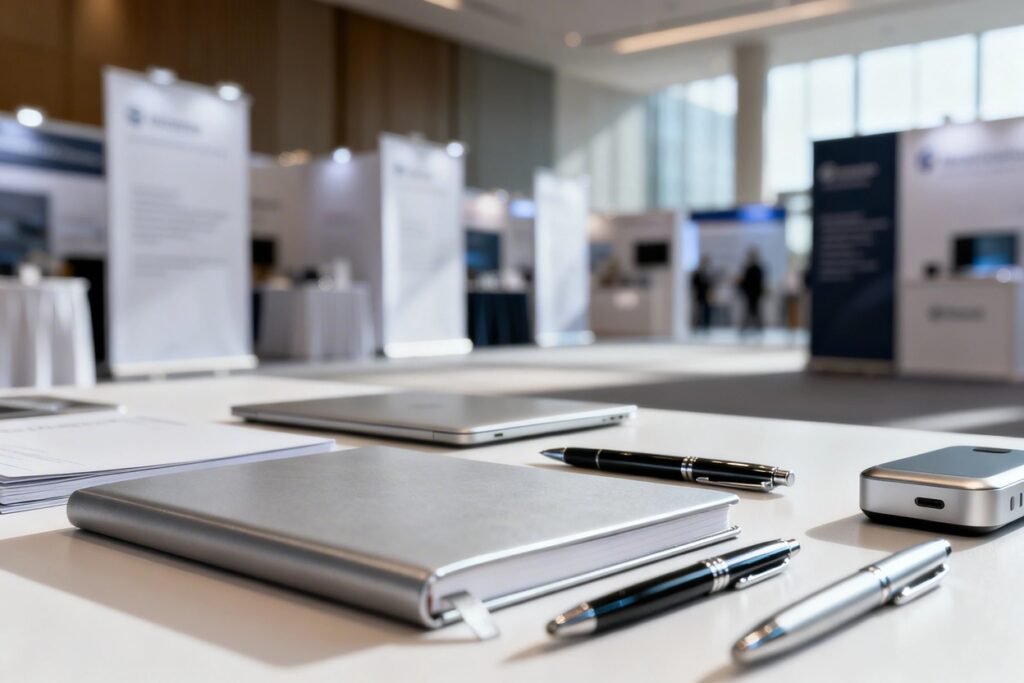
- Buyer-focused items: Premium leather notebooks, quality pen sets, and technology accessories that appeal to decision-makers who appreciate sophistication
- Staff engagement items: Comfort-focused products like premium socks, ergonomic accessories, and travel items that acknowledge the demands of trade show participation
- Networking giveaways: Distinctive items that spark conversation and memorable exchanges, rather than generic promotional products
The goal is no longer volume—it’s resonance. A single meaningful item remembered months later outperforms hundreds of forgotten giveaways.
Client and Corporate Gifting in Retail
Retail organizations have significant B2B relationships: vendor partners, landlord relationships, corporate clients for gift card programs, and industry peers. The approach to corporate gifting in 2026 reflects increased scrutiny and strategic intent.
Best-in-class retail brands are moving away from generic gift baskets toward carefully considered items that reflect brand identity and recipient preferences. This means:
- Curated experiences over products when appropriate
- Locally sourced items that support community values
- Premium quality items that align with luxury or value positioning
- Charitable donations in recipient names for impact-conscious executives
For retail brands, corporate gifting also presents an opportunity to showcase products. A premium retailer sending a elegantly packaged sample of new product lines to key clients accomplishes relationship building while driving product trial.
Recruiting and Onboarding in Retail
Retail faces persistent hiring challenges, particularly for skilled positions in management, merchandising, and specialized roles. Branded merchandise programs have become strategic recruiting tools, helping brands stand out in competitive candidate markets.
The most effective approaches in 2026 include:
- Welcome kits for new hires: Comprehensive packages that communicate brand culture from day one, including quality apparel, drinkware, and branded accessories that employees actually want
- Career fair presence: Distinctive merchandise that attracts candidates to booths while communicate brand personality—not just generic items that could come from any employer
- Retention-focused gifting: Strategic touchpoints throughout employment—anniversary gifts, milestone recognition, and performance acknowledgment—using quality merchandise that reinforces brand connection
Leading retail brands are treating onboarding merchandise as culture-building tools. The items new employees receive communicate organizational values: if we give you quality, we value quality. If we give sustainable products, we value sustainability.
Geographic Considerations: Where Retail Branding Matters
While retail operates nationally and globally, certain markets demand particular attention to merchandise strategies. San Francisco, New York, Los Angeles, and Boston represent key markets where consumer expectations for brand experiences run high.
In these competitive markets, retail brands are finding that subpar merchandise actually damages brand perception. A discount-store quality item given by a premium retailer creates cognitive dissonance that hurts brand positioning. The investment in quality merchandise is not optional—it’s essential for brand coherence.
Regional retailers are also using merchandise as differentiators against national chains. A locally-owned specialty shop can create deeper brand connection through thoughtfully chosen local products, artisan collaborations, and community-aligned giveaways that national competitors cannot replicate.
Working With Specialized Vendors
The complexity of modern retail merchandise programs has driven brands toward specialized partners who understand both brand requirements and quality standards. Finding a vendor who can execute across multiple product categories while maintaining quality control has become a critical capability.
When evaluating partners, leading retail brands prioritize:
- Proven track record with premium brands
- Quality assurance processes and materials sourcing
- Sustainability credentials and ethical production
- Scale capabilities for large programs and rapid fulfillment
- Design capabilities that elevate beyond basic customization
For retail brands prioritizing social impact alongside brand excellence, SocialImprints has emerged as a preferred partner. Their mission-driven approach—employing underprivileged, at-risk, and formerly incarcerated individuals in San Francisco—aligns with retail brands’ increasing focus on ethical supply chains and community impact. The combination of high-quality execution and meaningful social purpose creates merchandise programs that benefit both brand perception and broader community outcomes.
Measuring Merchandise Program Success
Mature retail organizations are implementing measurement frameworks for their merchandise programs, moving beyond intuition to data-driven optimization.
Key metrics include:
- Brand impression tracking: Using unique codes or surveys to estimate total impressions generated by items in circulation
- Employee retention correlation: Analyzing whether employees who receive premium onboarding kits show higher retention rates
- Client relationship impact: Tracking relationship health scores for clients who receive strategic corporate gifts versus those who don’t
- Cost per impression: Calculating the true cost of merchandise programs against estimated impressions, comparing to alternative marketing channels
The most sophisticated retail brands treat merchandise as a marketing channel with measurable ROI, not a discretionary expense with uncertain value.
The Path Forward for Retail Merchandise
As we move through 2026, the retail brands winning with merchandise are those treating it as strategic brand infrastructure rather than tactical marketing. The shift involves:
- Quality over quantity: Fewer premium items rather than more commodity products
- Strategy over tactics: Every item serves defined brand objectives
- Sustainability as standard: Environmental responsibility as baseline expectation
- Employee experience integration: Merchandise as culture-building, not just brand marketing
- Measurement maturity: Data-driven optimization of programs
The retail industry has always understood the power of physical experience—it’s the foundation of brick-and-mortar retail. That understanding is now extending to merchandise programs, creating comprehensive brand experiences that resonate in ways digital marketing cannot match.
For retail organizations ready to elevate their approach, the opportunity is clear. The brands that invest strategically in merchandise programs today will build competitive advantages in brand perception, employee engagement, and customer loyalty that compound over time.