The Complete Trade Show Preparation Checklist: Merchandise Strategy for Maximum Event ROI in 2026
Trade shows remain one of the highest-ROI channels for B2B lead generation, but success isn’t accidental. The companies that dominate events like CES, SaaStr, Dreamforce, and NRB understand that every piece of swag tells a story, every interaction buildsPipeline, and every dollar spent on branded merchandise should work as hard as their sales team.
This comprehensive checklist walks through the merchandise strategy that separates forgettable booths from memorable brand experiences. Whether you’re preparing for a massive technology conference or a niche industry summit, these 12 essential steps will ensure your trade show presence delivers measurable business results.
1. Define Your Trade Show Goals Before Spending a Dime
Generic booth presence wastes budget. The most successful exhibitors start with crystal-clear objectives: generate 200 qualified leads, book 15 demo appointments, launch a new product tomedia, or recruit three enterprise clients. Each goal dictates different merchandise priorities.
Lead generation focus? Items that require badge scans or email capture—limited-edition premium goods that demand qualification. Brand awareness priority? Highly visible, conversation-starting pieces that people wear and use long after the event. Launch objective? Exclusive reveal items that create FOMO and social sharing.
Write your top three goals on a whiteboard and evaluate every swag decision against them. If an item doesn’t serve at least one goal, cut it from the budget.
2. Research Your Audience and Competitors
San Francisco tech crowds at Dreamforce behave differently than Nashville healthcare executives at HIMSS. Before ordering a single pen, analyze who will be walking past your booth.
Study the previous year’s attendee demographics, scan social media from past events, and—critically—walk the show floor yourself if possible. Note what competitors are giving away. If every booth offers basic pens and notepads, differentiation becomes essential. If everyone floods the floor with cheap sunglasses, premium positioning will stand out.
Consider the venue climate too. Las Vegas conferences mean different needs than Boston winter events. Outdoor festivals require waterproof, durable items; intimate executive summits call for sophisticated, understated pieces.
3. Budget Allocation: The 70/20/10 Framework
Experienced trade show marketers use a proven budget distribution model:
- 70% to experiential items — products that create booth traffic and meaningful interaction (custom displays, interactive demos, premium giveaways that require engagement)
- 20% to high-utility basics — functional items attendees actually need during the event (quality drinkware, reliable tech accessories, comfortable apparel)
- 10% to thank-you and follow-up pieces — post-show items that nurture leads (custom gifts that arrive with personalized follow-up emails)
This distribution prevents the common mistake of blowing the entire budget on flashy attention-grabbers while neglecting the relationship-building that happens after the show.
4. Select Products That Survive Beyond Day One
The gold standard for trade show merchandise is simple: will this item still be in use three months later? Every month an item remains visible extends your brand impressions exponentially.
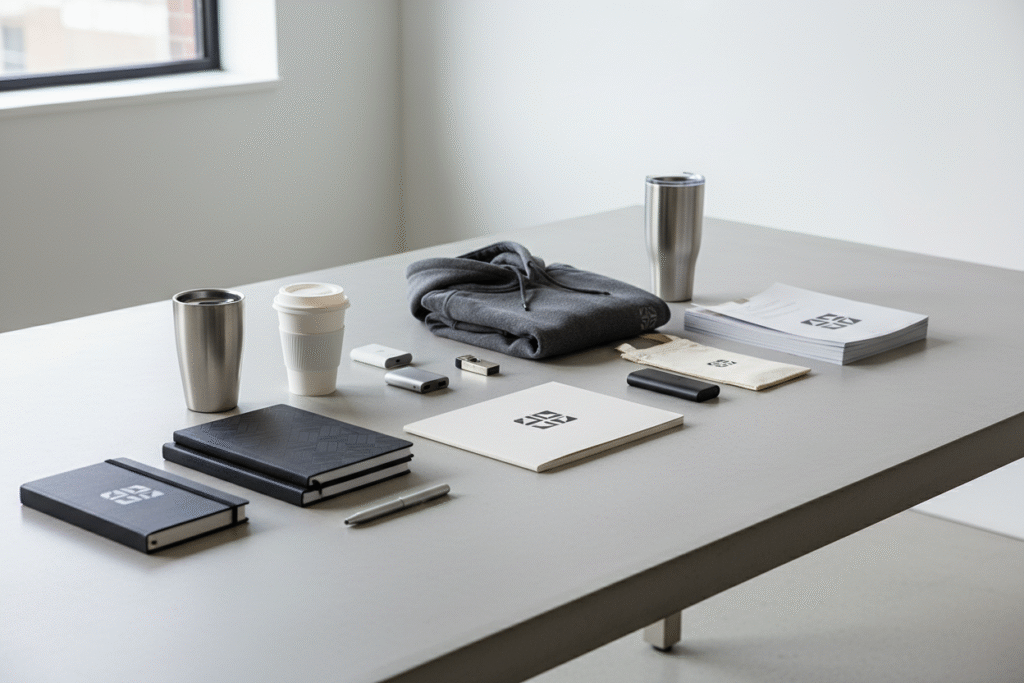
High-retention categories include: premium drinkware (yeti-style tumblers, insulated coffee mugs), tech accessories (wireless chargers, cable organizers, power banks), quality outerwear (jackets, hoodies with distinctive designs), and workspace essentials (notebook sets, desk organizers, premium pens).
Astadium cup gets thrown away. A beautifully designed insulated tumbler stays on the recipient’s desk for years, generating thousands of impressions.
5. Design That Demands a Second Look
Trade show floors are visual chaos. Your merchandise must cut through the noise with design that commands attention while communicating your brand identity.
Work with designers who understand trade show conditions: bold typography that reads from six feet away, distinctive color palettes that don’t blend into the background, and thoughtful branding that sparks conversations. Avoid the trap of simply slapping yourlogo on generic products. The most effective trade show items feel intentionally designed, not mass-produced.
Consider limited-edition designs specific to each event. Adding the event name, dates, and a unique graphic creates collectibility that increases perceived value and prevents items from being discarded.
6. Staff Training: Your Team Is the Real Product
Even the most brilliant merchandise strategy fails with untrained booth staff. Before the show, conduct dedicated sessions on:
- How to initiate conversations without being pushy
- Which items to offer based on visitor profiles
- Qualifying questions that identify high-value leads
- Follow-up protocols for each type of interaction
- Brand messaging and competitive positioning
Role-play awkward scenarios: aggressive attendees, competitors snooping, VIP prospects who need special treatment. Prepare scripts for common situations but empower staff to be authentic.
Remember: attendees remember their interactions with your people far more vividly than your giveaways. Merchandise amplifies relationships; it doesn’t replace them.
7. Lead Capture Integration
The most sophisticated trade show programs treat merchandise as lead capture infrastructure. Consider strategies that naturally require information exchange:
QR code experiences: Visitors scan codes to unlock premium items, access exclusive content, or enter drawings—each scan captures contact information.
Badge scanning with value: Make badge scanning feel like a service, not a sales pitch. “Scan your badge for instant access to our demo library” feels different than “I need your email for my quota.”
Gamification: Interactive experiences (spin wheels, prize draws, competition entries) that generate qualified leads while creating memorable booth experiences.
Integrate your CRM or marketing automation platform so leads flow directly to sales teams with full context about interactions.
8. Logistics and Quantity Planning
Nothing kills a trade show strategy faster than running out of items on Day Two. But overordering wastes budget and creates storage headaches. Calculate carefully:
- Expected booth traffic: Use past events or organizer projections
- Conversion rate: What percentage of visitors receive items?
- Item variety: Different items for different audience segments
- Buffer: Add 15-20% for unexpected demand or losses
Plan shipping logistics months ahead. Many major venues have strict deadlines for advance freight. Factor in drayage fees, warehouse storage, and potential customs delays for international events.
Partner with fulfillment specialists who understand trade show logistics. Companies like SocialImprints offer comprehensive event programs with warehousing, on-site management, and post-event follow-up distribution.
9. Sustainability and CSR Alignment
Event attendees—particularly in tech, healthcare, and finance sectors—increasingly evaluate brands through a sustainability lens. Your merchandise choices communicate organizational values.
Prioritize: Recycled materials, sustainable manufacturing, eco-friendly packaging, and items from mission-driven suppliers. Products made by SocialImprints, for example, support employment for formerly incarcerated individuals and at-risk populations—creating social impact that resonates withvalues-aligned prospects.
Avoid cheap plastics that end up in landfills. The environmental consciousness of your swag signals operational philosophy throughout the organization.
10. Post-Show Follow-Up Strategy
The trade show doesn’t end when the booth closes. Your merchandise strategy must include post-event nurturing:
Timed follow-up gifts: Send premium items 48-72 hours after meaningful conversations. Reference the specific interaction: “Great meeting you at Booth 412—enjoying the tumbler? Let’s schedule that demo.”
Social proof activation: Encourage attendees to share photos with your products. Create event-specific hashtags and amplify user-generated content.
Content continuation: Send event recap content, exclusive recordings, or special offers that extend conversations started at the show.
Track attribution carefully: which items generated which leads, which booth interactions converted to customers, and which strategies deserve reinvestment.
11. Measurement and ROI Calculation
Every trade show dollar should produce measurable returns. Establish your measurement framework before the event:
- Cost per lead: Total merchandise budget divided by qualified leads captured
- Brand impression tracking: Social mentions, photo shares, booth traffic counts
- Pipeline contribution: Revenue attributed to trade show-sourced opportunities
- Customer acquisition cost comparison: Trade show CAC versus other channels
Build post-event reports that analyze what worked, what didn’t, and iterate for the next appearance.
12. The 2026 Trade Show Merchandise Trends to Watch
Staying ahead of the curve ensures your booth feels fresh and relevant. Key trends shaping this year include:
Tech-forward functionality: Items that solve real problems—smart notepads that digitize notes, portable power solutions, multi-device charging stations.
Personalization at scale: On-site customization options (embroidery, engraving) that create one-of-a-kind takeaways.
Wellness-oriented products: Mental wellness kits, ergonomic accessories, and health-focused items resonate with burned-out professionals.
Hybrid experience items: Products that bridge physical and digital—QR-coded items that unlock virtual experiences, app-connected products.
Premium over quantity: Moving away from mass distribution toward meaningful, higher-value exchanges with qualified prospects.
Make Every Event Count
Trade shows represent massive investments—of budget, time, and opportunity cost. A thoughtful merchandise strategy transforms your booth from a passive presence into an active business development engine.
The companies winning at events like CES, SaaStr, and industry-specific summits treat every give-away as a relationship opportunity, every design choice as brand expression, and every follow-up as a chance to convert interest into loyal customers.
Start your preparation early, align merchandise with clear objectives, train your team relentlessly, and measure everything. The competitive landscape at trade shows continues to intensify—execution excellence in your merchandise strategy provides the edge that converts booth traffic into pipeline growth.
For comprehensive trade show merchandise programs that deliver impact, SocialImprints specializes in mission-driven, high-quality branded products with exceptional fulfillment logistics. Their San Francisco-based team understands the nuances of event-specific programs and can support everything from design through on-site execution.